Project Turaco Is Finally Showing Promise

Widely known as fotiecodes, an open source enthusiast, software developer, mentor and SaaS founder. I'm passionate about creating software solutions that are scalable and accessible to all, and i am dedicated to building innovative SaaS products that empower businesses to work smarter, not harder.
For more than a year, I have been trying to answer one question: can we build a machine translation model that translates English into natural Cameroon Pidgin without sounding like it is guessing?
That question became Project Turaco, my attempt to improve language technology for Cameroon Pidgin and other underrepresented African languages.
I initially thought modern foundation models would make the process easier. I experimented with several Llama checkpoints, Qwen, Gemini, Gemma E2B, and other models in between. Some could generate something resembling Pidgin, but they were unreliable as translators.
They hallucinated. They omitted parts of sentences. They sometimes returned explanations instead of translations. Other times, they mixed standard English, Nigerian Pidgin, and Cameroon Pidgin in ways that did not sound natural.
I kept experimenting with different prompts, datasets, training formats, and fine-tuning approaches, but nothing gave me the consistency I was looking for.
The real step forward came with translategemma, google’s translation-focused model family.
Instead of trying to turn a general-purpose language model into a translator, I was finally starting with a model already trained specifically to understand and translate languages. I fine-tuned google/translategemma-4b-it on our cleaned English–Cameroon Pidgin dataset and released the result as Turaco-gem-mt-en-wes.
Getting it trained was another challenge. I first tried using the free T4 GPU on Google Colab, but memory and compatibility issues made the full training unreliable. Eventually, I upgraded to paid Colab compute and ran the training on an A100 GPU with 40 GB of memory.
What surprised me most was how quickly the model began to improve. After training for just ~5 hours, the model was already producing translations that were noticeably more consistent, more complete, and more natural than the outputs from my earlier experiments.
The model was evaluated on 1,354 held-out sentence pairs:
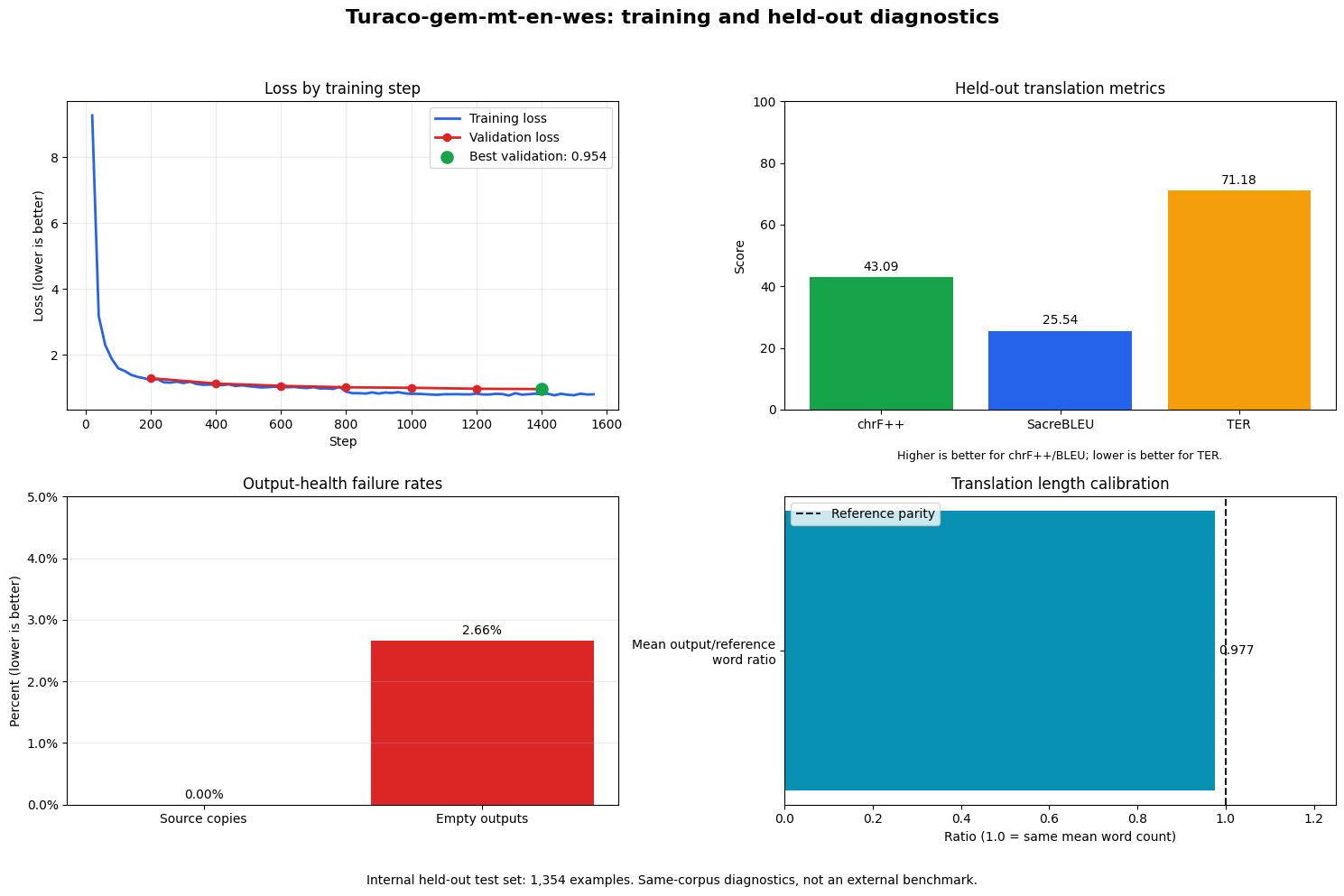
These numbers are not percentages of accuracy. chrF++ and BLEU measure how closely the translations match human references, while TER estimates how much editing would be needed to reach the reference translation.
The results show that the model has learned a real English-to-Cameroon-Pidgin translation capability. Many outputs preserve the meaning of the source while producing recognizable Pidgin grammar and vocabulary.
Still, I do not consider the work finished. Some translations contain formatting artifacts, some lose important details, and a small number return empty outputs. This is progress, not a claim that the problem has been solved.
There is also an important limitation in the dataset itself. Much of the available Cameroon Pidgin parallel data comes from biblical and religious material. As a result, the model has seen far more sentences about the Bible, congregations, and religious teachings than it has seen about markets, technology, healthcare, government services, entertainment, or everyday conversations.
That bias also affects the benchmark scores because the test data comes from the same general source.
The next step is not simply more training. It is better and more diverse data, created and reviewed by people who actually speak Cameroon Pidgin across different regions and contexts.
After more than a year of experiments, failed runs, hallucinations, and models that never quite worked, I can finally say that the results are promising.
Turaco-gem-mt-en-wes is not the destination. It is the clearest sign so far that this journey is heading somewhere real.
The model is available on Hugging Face: https://huggingface.co/fotiecodes/Turaco-gem-mt-en-wes